How to Take the Perfect Photo for Accurate Face Analysis
You upload a photo. The result comes back and something feels off. Your face shape looks wrong. Your symmetry score seems too low. Your age…

Powered by InsaneDev
Upload a photo and our Face Symmetry Test AI measures how closely the left and right sides of your face match, giving you a detailed symmetry score in seconds. It’s completely free, needs no signup, and your photo is deleted right after your result appears.
Our Face Symmetry Test tool uses advanced machine learning and AI vision technology to deliver precise results.



A face symmetry test is an AI powered tool that measures how closely the left half of your face mirrors the right half. Instead of guessing by eye, it uses facial landmark detection to compare specific points across both sides, such as eye position, eyebrow height, and jawline angle, then converts that comparison into a numeric score. This is different from a symmetry checker that simply overlays a mirrored image for a visual look, since an AI based test measures actual distances and angles rather than relying on a side by side visual impression.
People search for this in a lot of different ways, from a straightforward facial symmetry test to phrases like is my face symmetrical or how symmetrical is my face, and they’re all essentially asking the same underlying question. How closely do the two sides of your face actually line up, measured rather than guessed.
Once you upload a photo, the AI runs through the following steps automatically:
The full process usually takes 5 to 15 seconds.
If you want a rough idea before uploading a photo, a simple mirror check can help:
A mirror check gives you a general sense, but it’s harder to judge small differences by eye than it sounds. Almost everyone has some visible asymmetry once they look closely, which is normal rather than a flaw.
These two get confused often, so it’s worth separating them clearly:
The second type doesn’t measure anything, it just creates an edited image. Our tool is built as a measurement instrument, not an image generator, which is why you get a score and a landmark based breakdown instead of an edited photo.
| Score Range | What It Suggests |
|---|---|
| 90–100 | Very close alignment between both sides across most facial regions. |
| 75–89 | Solid overall symmetry with minor natural variation. This is where most people land. |
| 60–74 | Noticeable but common asymmetry, often concentrated in one or two facial regions. |
| Below 60 | More pronounced asymmetry, while still remaining within normal human variation. |
Perfect facial symmetry is rare. Human faces almost always show measurable differences between the left and right sides, and a lower score does not mean a face is unattractive or abnormal.
| Facial Third | Measured From |
|---|---|
| Upper Third | Hairline to eyebrows |
| Middle Third | Eyebrows to the base of the nose |
| Lower Third | Base of the nose to the chin |
Equal facial thirds are another classical proportion concept, separate from left-to-right symmetry but often discussed alongside it. Very few faces have perfectly equal thirds, and like facial symmetry, this is a descriptive measurement rather than a requirement for attractiveness.
Some psychological research has found a mild association between symmetry and perceived attractiveness, but the relationship is weaker and more complicated than popular science articles often suggest. A few things worth knowing:
Treat your score as an interesting structural measurement, not a verdict on how attractive you are.
A few assumptions worth correcting, since they shape how people interpret their own score:
Almost everyone has some degree of facial asymmetry, and it usually comes from a mix of the following:
None of these are unusual, and most people never notice their own asymmetry until they compare a mirrored version of their photo to the original. It’s also worth knowing that dominant handedness has been loosely linked to minor asymmetry in some studies, likely tied to habitual muscle use on one side of the body extending subtly to the face, though this connection is far less established than the causes listed above.
Underlying bone structure is essentially fixed after facial growth is complete, so most claims about dramatically changing symmetry through exercises or habits are overstated. That said, a few things can have a small, gradual influence:
For any noticeable asymmetry that concerns you, a dentist, orthodontist, or physician is better positioned to assess the actual cause than any online tool.
Also you can try our AI-powered Tool: Doppelganger Finder
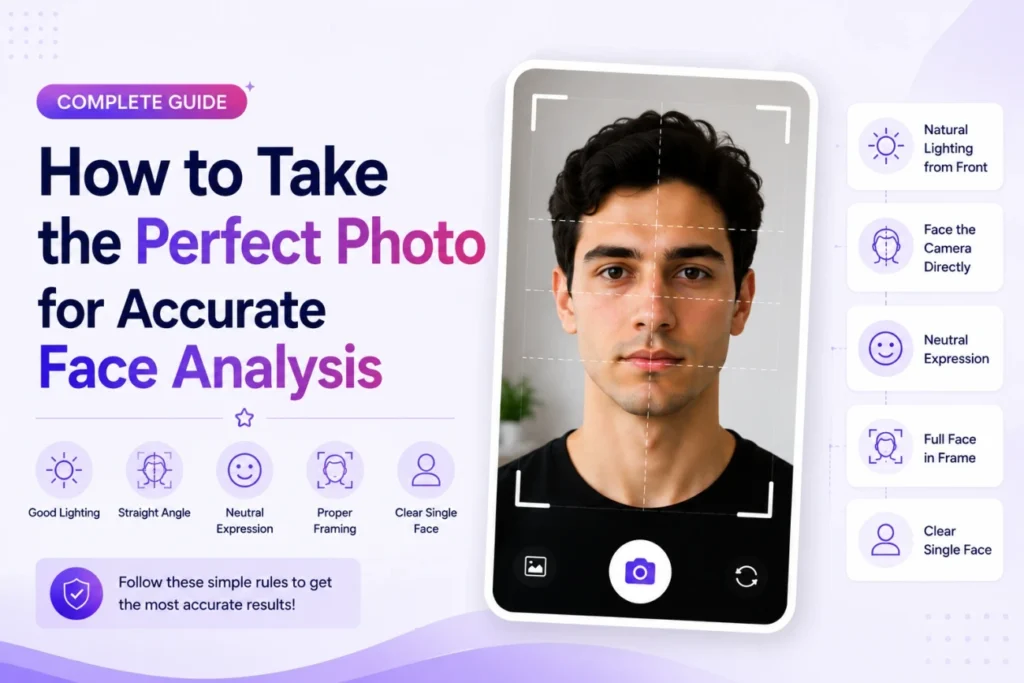
A few adjustments noticeably improve how reliable your symmetry score is:
Nothing stays behind. Once your result appears on screen, your photo is deleted from our system immediately. There is no account created, no image storage, and nothing retained afterward. Full details are available in our Privacy Policy.
The Face Symmetry Test is one part of a larger collection of AI-powered facial analysis tools, all using the same
no-account, no-storage approach.
Upload a clear, front-facing photo and discover how symmetrical your face is, along with a detailed breakdown of where your natural asymmetry appears.
Curious about the science behind your score? Read what facial symmetry actually measures and why, or see which celebrities score highest on facial symmetry.
Almost every face has some natural asymmetry. Upload a photo to our Face Symmetry Test to get an actual measured score instead of guessing.
Yes. Real human faces almost always show measurable differences between the two sides, even among people widely considered attractive.
Yes. Genetics, sleeping position, chewing habits, and natural growth patterns all contribute to some degree of asymmetry in almost everyone.
No. The tool works without any account or login.
Yes. Since jaw and bite alignment shift during treatment, dental work can subtly influence facial symmetry over time.
Check eyebrow height, eye position, and smile alignment in a mirror with even lighting on both sides, though small differences are hard to judge accurately by eye alone.
Most people score between 75 and 89, which reflects solid overall symmetry with normal, minor variation.
Over many years, consistently sleeping on one side can apply gradual pressure that contributes to subtle asymmetry.
Accuracy depends on photo quality. A front facing photo with even lighting and a neutral expression gives the most reliable result.
Yes. It’s completely free with no signup required, and your photo is deleted immediately after your result appears.
Not necessarily. Research shows only a mild link between symmetry and perceived attractiveness, and many other factors matter just as much.
Written by Ahsan Fayyaz, founder and developer of Stardoppel.
Last updated: July 2026.