The Science of Doppelgangers: Why Unrelated People Look Alike
Nearly everyone has had the experience of seeing a stranger and thinking they look exactly like someone they know. This is not just a coincidence…

Powered by InsaneDev
Upload a photo and our AI measures your facial proportions against the golden ratio, 1.618, giving you a real harmony score based on your own structure, not filters or guesswork.
Disclaimer: I am 16+ and give permission to process my photo one time for analysis. It is not saved and is erased after processing.
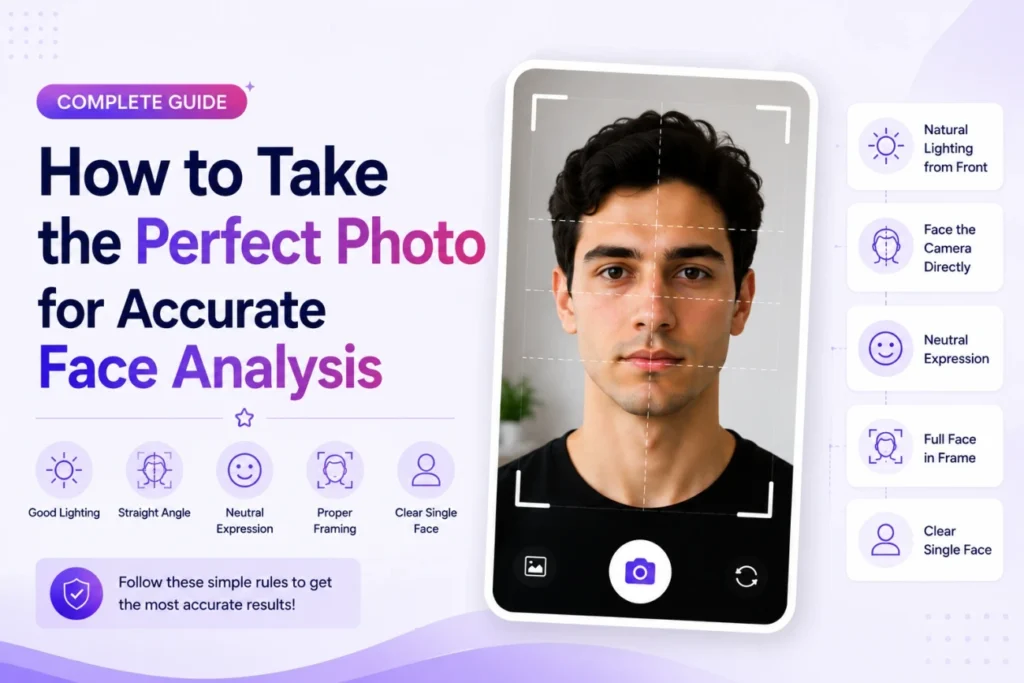
Following these steps ensures accurate golden ratio face comparison results. Try our AI-Powered Tool to see how your features measure up and gain personalized insights.



The golden ratio is roughly 1.618, and it shows up in places that have nothing to do with each other:
None of this means 1.618 is some hidden law of beauty baked into the universe. It means people have repeatedly noticed that certain proportions feel visually settled, and this particular ratio kept showing up when they tried to explain why.
There is also a less flattering side to this history worth mentioning. Over the last century, the golden ratio has occasionally been stretched into claims about which faces are objectively superior, sometimes tangled up with ideas that have nothing to do with mathematics and everything to do with bias. We are not interested in reviving any of that. We are interested in giving you a real number based on your real face, and letting you decide what it means to you.
The path from ancient sculpture to a modern face-scanning tool isn’t a straight line. A few stops along the way are worth knowing:
It’s a useful language for discussing proportion. It was never meant to be a biological law, and it still isn’t one.
Also you can try our AI-powered Tool: Doppelganger Finder
Once you upload a picture, our system works through a few steps automatically:
We are not comparing your face to a celebrity or to some idealized composite face. We are comparing parts of your own face to other parts of your own face, which is why the result reflects your actual structure rather than how closely you resemble anyone else.
Each of the following is scored individually, then combined into your overall harmony score.
| Measurement | What’s Compared |
|---|---|
| Face Height Ratio | Upper face length vs. lower face length |
| Eye–Mouth Ratio | Distance between eyes vs. mouth width |
| Nose–Chin Ratio | Nose length vs. chin length |
| Eye Spacing | Distance between eyes vs. eye width |
| Face Width Ratio | Width at forehead, cheekbones, and jaw |
| Score Range | What It Suggests |
|---|---|
| 85–100 | Proportions closely follow the 1.618 ratio across most measurements. |
| 65–84 | Solid balance with a few ratios further from φ. This is where most people land. |
| Below 65 | More distinct proportions that diverge from the classical Golden Ratio. |
A lower score doesn’t mean less harmonious in any real sense. Wider set eyes, a more prominent jaw, or a nose with more character are the kinds of features that make a face memorable rather than the kind that blend into an average. Plenty of faces widely considered attractive score outside the ideal range specifically because their features stand out rather than average out.
People often mix these two up, so it’s worth separating them clearly:
A face can score high on one and average on the other. They’re related ideas, both used to talk about facial balance, but they’re answering different questions. If you’re curious about the symmetry side specifically, our Face Symmetry Test covers that in more detail.
We built this tool to be accurate about proportion, not to make claims about beauty as a whole. A few things worth keeping in mind:
A few things affect accuracy, and most are simple to control:
Nothing. Once your proportions are calculated and your results appear on screen, your photo is deleted from our system. We don’t create an account for you, we don’t store the image, and we don’t hold onto it for any reason afterward.
We built the tool this way on purpose. People upload a personal photo to get a specific answer, not to hand over an image that sits somewhere indefinitely. Full details are in our Privacy Policy.
Just as important as what the tool does well is what it was never built to answer:
The golden ratio test is one piece of a larger set of tools built around facial analysis, all using the same landmark detection approach and the same no-account, no-storage setup:
Upload a clear photo, see where your proportions land, and take the number for what it actually is. A specific measurement, not a judgment.
Want to dig into the history and psychology behind this idea? Read where the golden ratio concept actually comes from.
No. The tool compares your own measurements to each other, not to population averages tied to age or ethnicity.
Underlying bone structure doesn’t change, but camera angle, lighting, and expression all affect how a given photo is measured.
Not necessarily. Golden ratio alignment is one small factor among many, and not the most predictive one in attractiveness research.
No. Golden ratio measures the relationship between different features against 1.618, while symmetry measures how closely the left and right sides of your face mirror each other.
Usually 5 to 15 seconds from upload to result.
No. It’s a historical framework used in art and architecture long before it was applied to faces, not a biological law or a settled scientific standard.
Yes. The measurements are based on your individual facial landmarks, not a template tied to a specific gender.
No. There’s no signup required, and no account is created when you upload a photo.
JPG, PNG, and WEBP files up to 10 MB, with a clear, front-facing shot giving the most accurate reading.
Angle, lighting, distance from the camera, and expression all shift the raw pixels the tool measures, even though your actual structure hasn’t changed.
Written by Ahsan Fayyaz, founder and developer of Stardoppel.
Last updated: July 2026.