
Search “what’s my nose type” and you’ll find a scattered mess of forum threads, half-answered Reddit posts, and quizzes that ask you to pick from three blurry illustrations. Nose type is one of those things almost everyone is curious about but rarely gets a clear, structured answer to. This guide breaks down what nose type actually means, the main categories that exist, what determines them, and how you can accurately find out your own.
What Is a Nose Type?
A nose type is a descriptive classification of nose structure based on the shape of the bridge, the angle of the tip, and the width of the nostrils. It is not a medical term and not a rigid scientific category, it’s shorthand used in photography, styling, art history, and everyday conversation to describe how a nose reads visually.
Unlike facial expressions or hairstyles, nose type doesn’t change moment to moment. It’s set almost entirely by cartilage and bone formed during childhood and adolescent growth, which is exactly why nose type categories tend to stay consistent and recognizable across a person’s adult life.
Why Nose Type Matters
People look into their nose type for a range of reasons that have nothing to do with dissatisfaction:
- Photographers use it to understand flattering angles and lighting for portraits
- Makeup artists and contouring enthusiasts use it to guide technique
- Some people are simply curious about their ancestry and genetics
- Illustrators and character designers reference nose type categories for realistic facial variation
Knowing your nose type is descriptive information, not a judgment. Every nose type shows up across cultures, art history, and modern photography in ways that are considered striking, distinctive, or classically balanced, depending entirely on context and personal taste.
The Main Nose Types Explained
There isn’t one single official list, but a handful of categories come up consistently across styling guides, anthropology literature, and photography references.
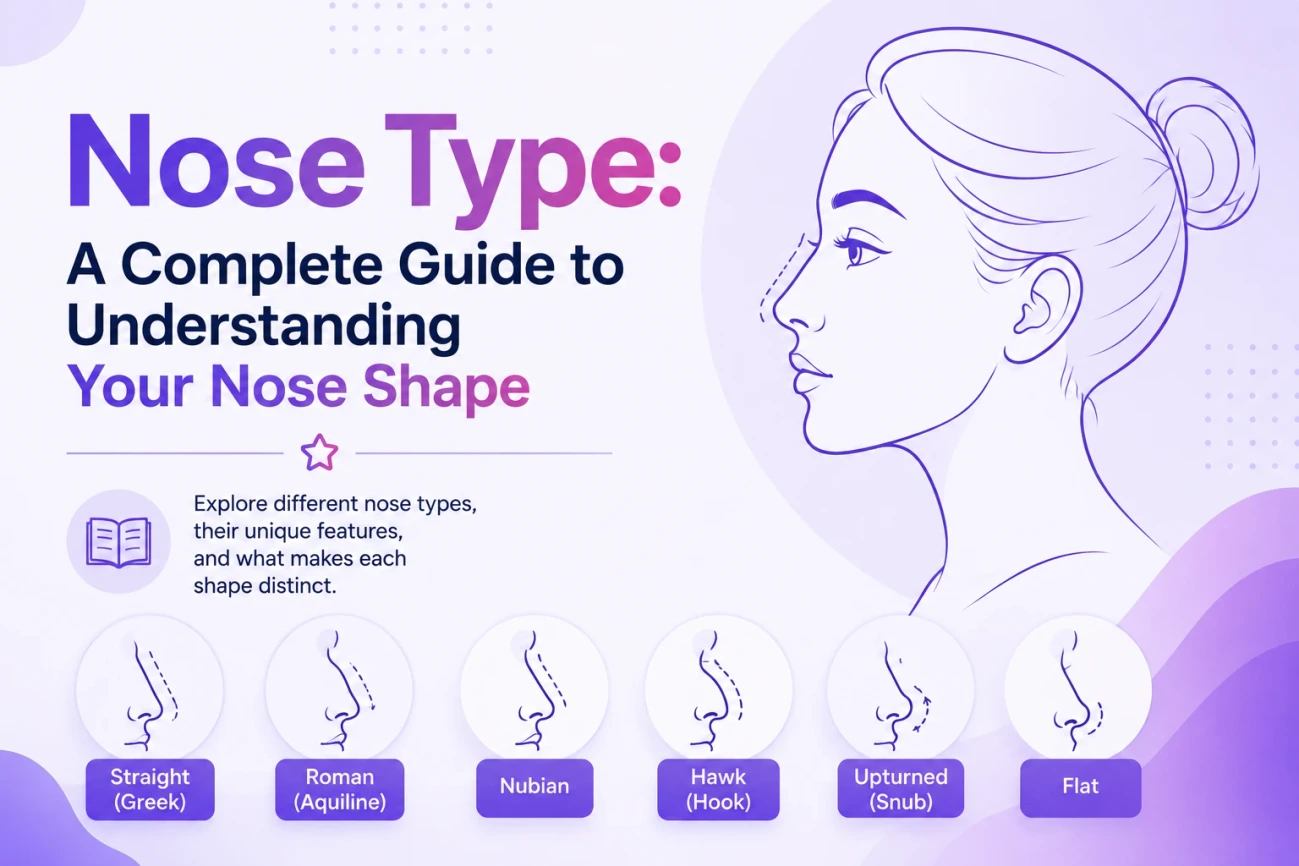
Straight (Greek) Nose Type
This nose type has a smooth, continuous line from the root, between the eyes, down to the tip, without any noticeable curve or bump along the bridge. It’s frequently referenced in classical Greek sculpture, which is where the name comes from, and is often described as visually balanced from a side profile.
Roman (Aquiline) Nose Type
The Roman, or aquiline, nose type has a slight outward curve along the bridge, creating a convex line when viewed from the side. This nose type has appeared consistently in classical portraiture and statuary and tends to read as strong or defined in profile.
Nubian Nose Type
The Nubian nose type features a longer bridge paired with wider nostrils. It’s common among people of African heritage and is a clear example of healthy, natural nose structure variation across global populations, not a deviation from some other “standard.”
Hawk (Hook) Nose Type
This nose type has a pronounced downward curve concentrated at the tip, giving the profile a bold, hooked appearance. It’s one of the more visually distinctive nose types and is easy to identify from a side angle specifically because of that downward curve.
Upturned (Snub) Nose Type
The upturned or snub nose type has a tip that angles slightly upward, which makes the nostrils a bit more visible from a front-facing view compared to other types. It’s often mixed up with a “button nose,” but the defining trait specifically is the upward angle of the tip, not overall size.
Flat Nose Type
A flat nose type has minimal bridge projection and a broader overall structure. It’s common across many Asian and African populations and is a useful reminder that there’s no single universal nose type considered biologically “ideal,” proportions and structure vary meaningfully by ancestry.
Nose Type Comparison At A Glance
| Nose Type | Bridge | Tip | Common Characteristics |
|---|---|---|---|
| Straight (Greek) | Smooth, no curve | Level, in line with bridge | Balanced profile, no dips or bumps |
| Roman (Aquiline) | Slight outward curve | Slightly angled downward | Strong, defined side profile |
| Nubian | Longer, moderate height | Rounded | Wider nostrils, longer bridge |
| Hawk (Hook) | Curved | Pronounced downward hook | Bold, dramatic profile |
| Upturned (Snub) | Shorter | Angled upward | More visible nostrils from the front |
| Flat | Minimal projection | Rounded, low projection | Broader overall structure |
How Nose Type Is Determined
Genetics and Bone Structure
Nose type is primarily inherited. The cartilage that forms the tip and the bone that forms the bridge develop according to genetic instructions passed down from both parents, which is why nose type often runs recognizably in families.
Ancestral and Environmental Adaptation
Interestingly, nose structure isn’t random from an evolutionary standpoint. Research in physical anthropology has linked nostril width and bridge height to historical climate adaptation, nose structure affects how efficiently air is humidified and warmed before reaching the lungs, which varied in importance depending on the climate a population’s ancestors lived in over many generations.
Growth and Development
The nose continues developing through childhood and adolescence and generally reaches its adult structure by the late teens to early twenties. After that point, the core nose type is largely fixed, aside from minor softening of cartilage that can occur with age or changes following an injury.
How To Find Out Your Nose Type
The Traditional Way
Most people try to identify their own nose type by looking in a mirror, usually from a front-facing angle. The problem is that bridge curvature and tip projection, the two traits that actually define most nose types, are far easier to judge from a side profile than head-on, and self-assessment from a flipped mirror image tends to be unreliable.
Using An AI Nose Type Detector
A more consistent way to identify your nose type is through AI-based facial analysis. Tools like this map key landmarks along the nose, the root, the bridge, the tip, and the outer edges of the nostrils, then measure the actual angles and proportions between them rather than relying on a subjective glance. Because the measurement is based on fixed points rather than a mirror impression, the result stays consistent regardless of lighting mood or which angle you’re used to seeing yourself from.
Nose Type vs. Face Shape: Are They Related?
These two get confused constantly, but they’re independent traits. Face shape refers to your overall head outline, oval, round, square, heart, or diamond, while nose type is specific to the nose alone. A round face can be paired with a straight nose, a hawk nose, or any other type, there’s no rule linking the two together, and knowing one doesn’t tell you anything about the other.
Common Misconceptions About Nose Type
“There’s one ideal nose type.”
Not true. Nose type varies meaningfully by ancestry and population, and what’s considered visually striking shifts constantly across art history, fashion eras, and culture. There’s no biologically superior nose type, only different structural starting points.
“Nose type changes a lot with age.”
Minor softening of cartilage can occur, which is why some people notice a very slight change in tip definition later in life, but the core bridge and bone structure set during growth stays largely consistent through adulthood.
“A wider or flatter nose type is less common.”
It’s actually extremely common globally, flat and Nubian nose types appear across a huge portion of the world’s population. Perceived “commonness” often just reflects which nose types get overrepresented in Western media rather than actual global prevalence.
Nose Type vs. Nose Function
It’s worth separating appearance from function clearly. However much attention nose type gets for styling or curiosity, breathing function is the more important consideration medically. Persistent congestion, frequent nosebleeds, or difficulty breathing through one side are health questions, not cosmetic ones, and they’re usually linked to specific structural issues like a deviated septum rather than nose type itself. Anyone experiencing ongoing breathing difficulty should see a doctor rather than trying to self-diagnose through appearance alone.
You Might Also Like
Nose type is just one piece of understanding your overall facial structure. If you’re curious about the rest, these tools cover the other major features:
- Face Shape Detector — find out whether your overall face outline is oval, round, square, heart, or diamond
- Eye Shape Detector — identify your exact eye shape and the makeup techniques built around it
- Lip Shape Detector — measure your lip proportions, symmetry, and cupid’s bow definition
- Golden Ratio Face Test — see how closely your facial proportions align with the classical 1.618 ratio