
The phrase “facial harmony” shows up constantly in beauty and cosmetic conversations yet it rarely gets explained properly. This guide traces where the concept actually originated, what the golden ratio has and has not been shown to explain, and what psychological research genuinely says about what drives how we perceive faces.
A Brief History of Measuring Facial Beauty
The idea that beauty could be captured through mathematical proportion is far from a modern invention. Ancient Greek sculptors worked from idealized canon of proportion systems when creating figures such as Polykleitos’s Doryphoros aiming for specific mathematical relationships between the body and the face. The golden ratio itself gained prominence partly through its appearance in nature including shell spirals and plant growth patterns and partly through Renaissance artists and mathematicians including work associated with Leonardo da Vinci who explored proportion systems across human anatomy.
By the twentieth century the golden ratio had been adopted and arguably stretched well beyond its original context into cosmetic medicine and popular beauty culture as a way to give proportion discussions a scientific sounding vocabulary. What started as an art history concept slowly turned into a marketing shorthand used across skincare ads plastic surgery consultations and countless online quizzes.
What the Golden Ratio Actually Measures
The golden ratio, written as phi and equal to roughly 1.618, is a mathematical proportion that shows up throughout nature art and architecture. Applied to a face it measures how closely certain facial distances relate to one another compared to this specific ratio.
Three relationships get measured most often in this kind of analysis. The distance from the eyes to the mouth compared against total face height. The distance from the nose to the chin compared against the same face height measurement. And the spacing between the eyes compared against overall face width. When a given pair of measurements lands close to a 1 to 1.618 relationship it is considered to align with the golden proportion.
It is worth being direct about what this actually is. It is a geometric comparison, not a biological law and not a validated predictor of attractiveness on its own. It gives a structured way to talk about proportion which is different from proving that proportion determines how appealing a face is perceived to be.
What Psychological Research Actually Shows About Attractiveness
This is where it becomes important to separate popular claims from actual research findings. Studies in facial attractiveness research have consistently pointed to a handful of factors that matter more reliably than golden ratio alignment specifically.
Averageness
Faces that sit closer to the mathematical average of a population rather than being extreme in any one feature are frequently rated as more attractive across psychological studies. This is a distinct concept from the golden ratio since averageness is about general typicality rather than one specific mathematical proportion.
Symmetry
Modest associations between facial symmetry and attractiveness ratings appear across multiple studies though the effect size tends to be smaller than popular discussion around it suggests.
Skin Quality
Even healthy looking skin texture consistently influences attractiveness ratings, arguably more reliably than any single structural proportion measured on the face.
Expression and Familiarity
Context matters far more than most people assume. The exact same face gets rated differently depending on expression and repeated exposure to a face tends to increase how positively it gets perceived, a pattern researchers call the mere exposure effect.
The golden ratio specifically has much weaker direct research support as a predictor of attractiveness compared to these other factors. It functions more as a historical aesthetic framework passed down through art and design than as a validated psychological model of what people actually find appealing.
Why the Golden Ratio Framework Persists Anyway
Despite limited direct research support the golden ratio remains popular in beauty marketing and cosmetic consultation for a fairly understandable reason. It offers a concrete measurable vocabulary for discussing something that is otherwise highly subjective. Telling someone their proportions feel slightly off is vague. Measuring a specific ratio against 1.618 feels precise even when the underlying connection to actual attractiveness is looser than that precision implies.
This does not make the framework useless. It remains a legitimate tool for discussing structure and balance in a shared language that photographers stylists and cosmetic professionals can all reference. It simply works best when treated as one lens among several rather than a definitive formula for beauty.
How the Three Ratios Get Measured
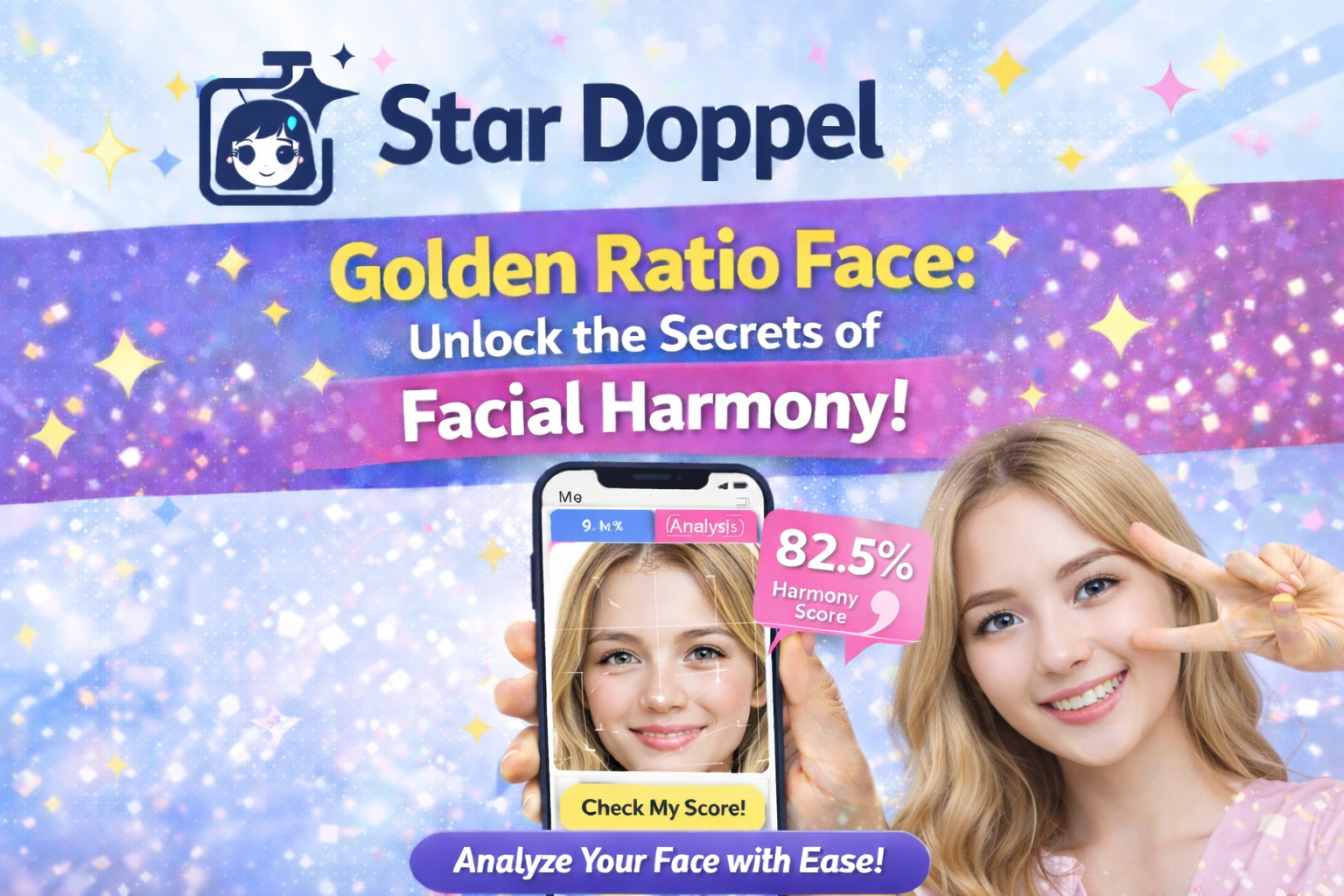
Understanding the mechanics behind a golden ratio score makes the whole concept far less mysterious. The analysis starts by placing landmark points at specific facial features, the outer corners of the eyes, the center of the mouth, the tip of the chin, and the top of the forehead along the hairline. From those points three separate distance measurements get calculated and compared against each other.
Eye to Mouth Ratio
This compares the vertical distance between the eyes and the mouth against the total height of the face. A relationship close to 1 to 1.618 between these two measurements is considered aligned with the golden proportion.
Nose to Chin Ratio
This compares the distance from the base of the nose to the bottom of the chin against the same overall face height measurement used above. This particular ratio tends to shift more noticeably with jaw structure and chin projection than the other two.
Eye Spacing Ratio
This compares the horizontal distance between the eyes against the total width of the face. Since eye spacing is one of the more visually noticeable proportions people tend to focus on this measurement more than the other two when reading their own results.
Each of the three ratios contributes to an overall harmony score, though it is worth repeating that this score reflects a geometric comparison rather than any kind of medical or psychological measurement of appeal.
Common Misconceptions About the Golden Ratio and Faces
Myth: A Face That Perfectly Matches Phi Would Be Objectively Beautiful
Researchers who have tested this by digitally constructing faces built precisely around golden ratio proportions found the results often read as generic or even slightly uncanny rather than more appealing. Real memorable faces almost always deviate from the ratio in at least one measurement.
Myth: The Golden Ratio Is a Modern Scientific Discovery Applied to Faces
The proportion itself has been documented mathematically for centuries and its application to art and anatomy dates back to ancient and Renaissance sources long before any cosmetic industry adopted the language for marketing purposes.
Myth: A Low Score Means Your Face Is Unbalanced or Flawed
A lower alignment with phi simply means your specific proportions sit further from this one mathematical benchmark. It says nothing about symmetry, skin quality, or the averageness factors that research actually links more consistently to attractiveness ratings.
Practical Uses That Do Not Overstate the Science
Photography
Understanding your own proportions can help identify flattering angles for photos regardless of whether those proportions align closely with phi or not.
Makeup and Contouring
Makeup professionals use proportion awareness including but not limited to golden ratio concepts to guide shading and highlighting decisions across different face structures.
Self Understanding
Simply learning the vocabulary of facial proportion, including thirds ratios and symmetry, can make it easier to articulate what you do or do not like about a given photo or angle independent of chasing any single ideal target.
What a Golden Ratio Score Does Not Tell You
It is worth being clear about the limits here since so much online content implies the opposite. A high or low score does not correlate reliably with how attractive other people will find a specific face since attractiveness research points more consistently toward averageness symmetry and skin quality as described earlier. Many widely admired faces show proportions that diverge meaningfully from phi rather than converging toward it, since distinctive memorable features are often exactly what pulls a face away from a mathematical average.
A score is best treated as a fun structural curiosity rather than a verdict on appearance. It reflects one specific geometric comparison and nothing more.