Scroll through any kpop fan community for long enough and you will run into the same comment over and over: “you kind of look like any famous kpop star.” It shows up in group chats, under selfies, in fancam comment sections, and eventually it turns into an actual search: kpop celebrity look alike. The jump from a passing comment to something people actively look up says a lot about how deep this comparison habit runs in kpop fandom specifically.
Where the Kpop Celebrity Look Alike Trend Started
Kpop fandom has always paid close attention to faces. Idols are scouted young, trained for years, and presented with a level of visual polish that makes fans naturally start sorting and comparing features, who has similar eyes, who shares a jawline, which two members from different groups could pass as siblings. Fan edits comparing idols to each other have circulated for years on Twitter and Tumblr long before any of this had an AI tool attached to it.
What changed is the direction of the comparison. Instead of only comparing idol to idol, fans started asking the question about themselves: which idol do I actually resemble, not personality-wise, but structurally.
Why Fans Compare Themselves to Idols
Shared Group Aesthetics
Kpop groups are built around a visual identity as much as a musical one. Styling, hair color, and even posing conventions are chosen to make a group instantly recognizable, which trains fans to think in terms of specific, nameable facial features rather than a vague “good looking” label. That habit carries over naturally into looking at your own face the same way.
The Rise of AI Face Matching
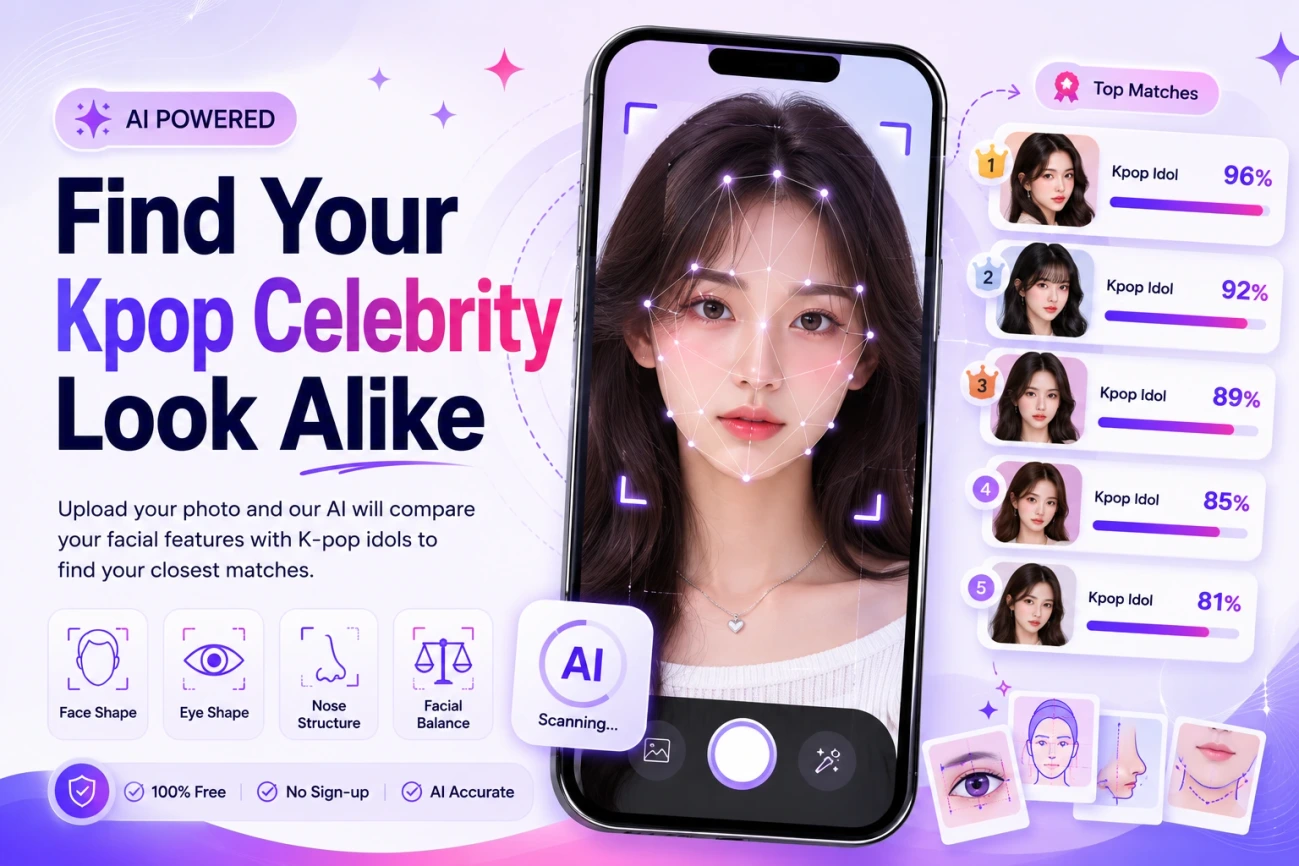
Personality quizzes used to fill this space, pick a color, answer a few questions, get assigned a member. They are fun, but they answer a different question than the one most people are actually curious about. An AI-based celebrity look alike finder instead works from an actual photo and measured facial proportions, which is a more literal answer to “who do I look like” than any quiz can give.
What Actually Makes Two Faces Look Alike
Resemblance, in a measurable sense, usually comes down to a handful of structural traits lining up at the same time rather than one standout feature: the ratio of face length to width, how far apart the eyes sit relative to that width, the angle of the jaw as it narrows toward the chin, and the general shape and projection of the nose. Two people can have a completely different overall vibe and still share enough of these underlying ratios to read as a close match.
This is also why kpop look alike results can feel surprising at first. A match is based on proportion, not styling, so someone with a totally different hair color, body type, or personal style can still come back as a strong structural match.
Kpop Groups Fans Ask About Most
A handful of groups come up constantly whenever this topic gets discussed:
- BTS — the most searched version of this question by a wide margin, going back to the personality-quiz era of kpop fandom.
- BLACKPINK — fans here tend to want an actual face comparison rather than a vibe match, given how distinct each member’s styling is.
- Stray Kids — an eight-member lineup means more idols in the comparison pool and a wider spread of results.
- SEVENTEEN — thirteen members across three sub-units makes this one of the largest single-group comparisons in kpop fandom.
The underlying question is the same every time, people just attach it to whichever group they follow most closely.
A Fun Trend, Not a Science
However it gets answered, a kpop look alike result is entertainment, not a verdict on appearance and not a claim of identical looks. It is a way of noticing something specific and structural about your own face through the lens of a group of people whose faces fans already study closely. That mix of curiosity and fandom is exactly why the question keeps resurfacing with every new debut, every new “who do I look like” thread, and every new wave of fans discovering the comparison for the first time.