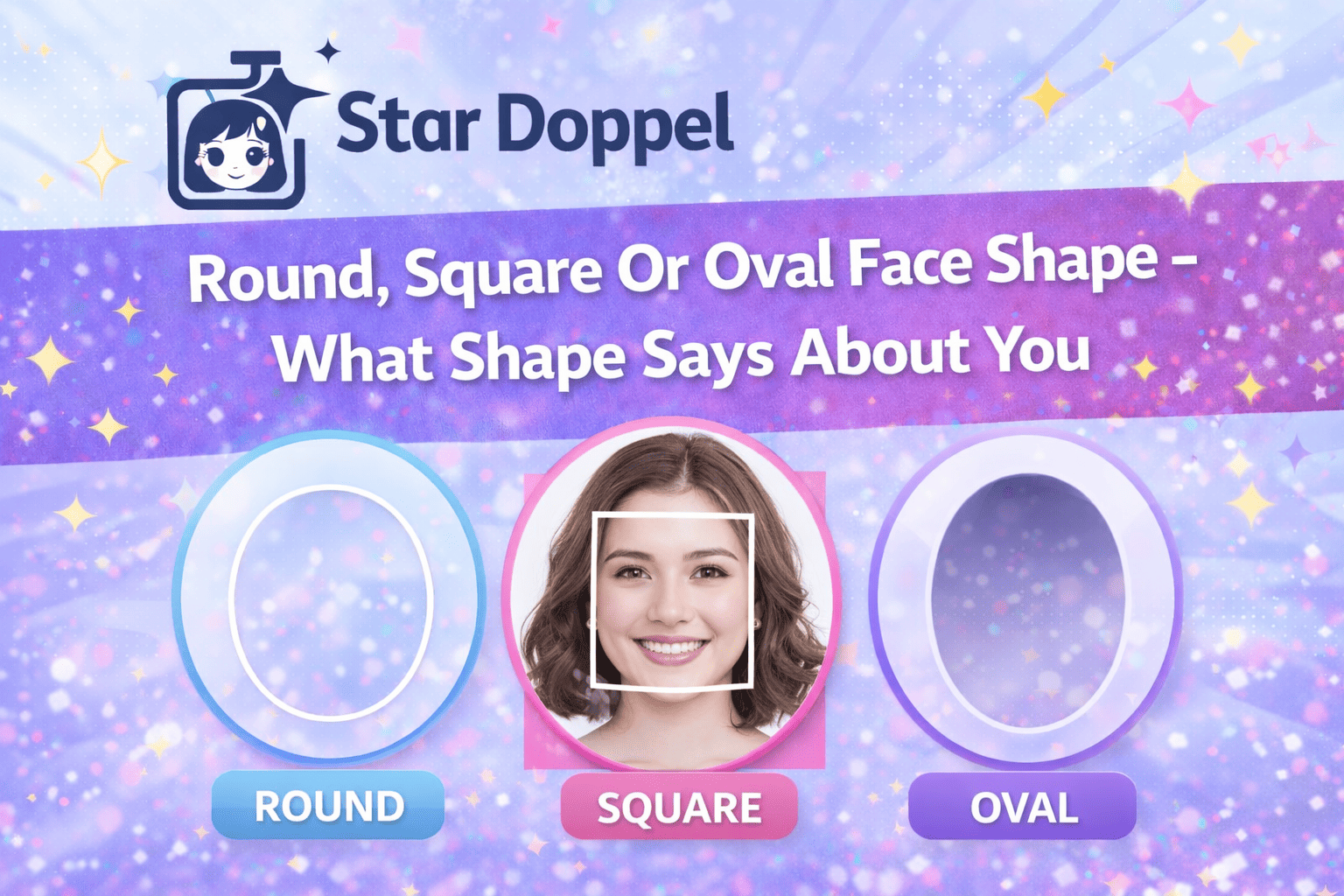
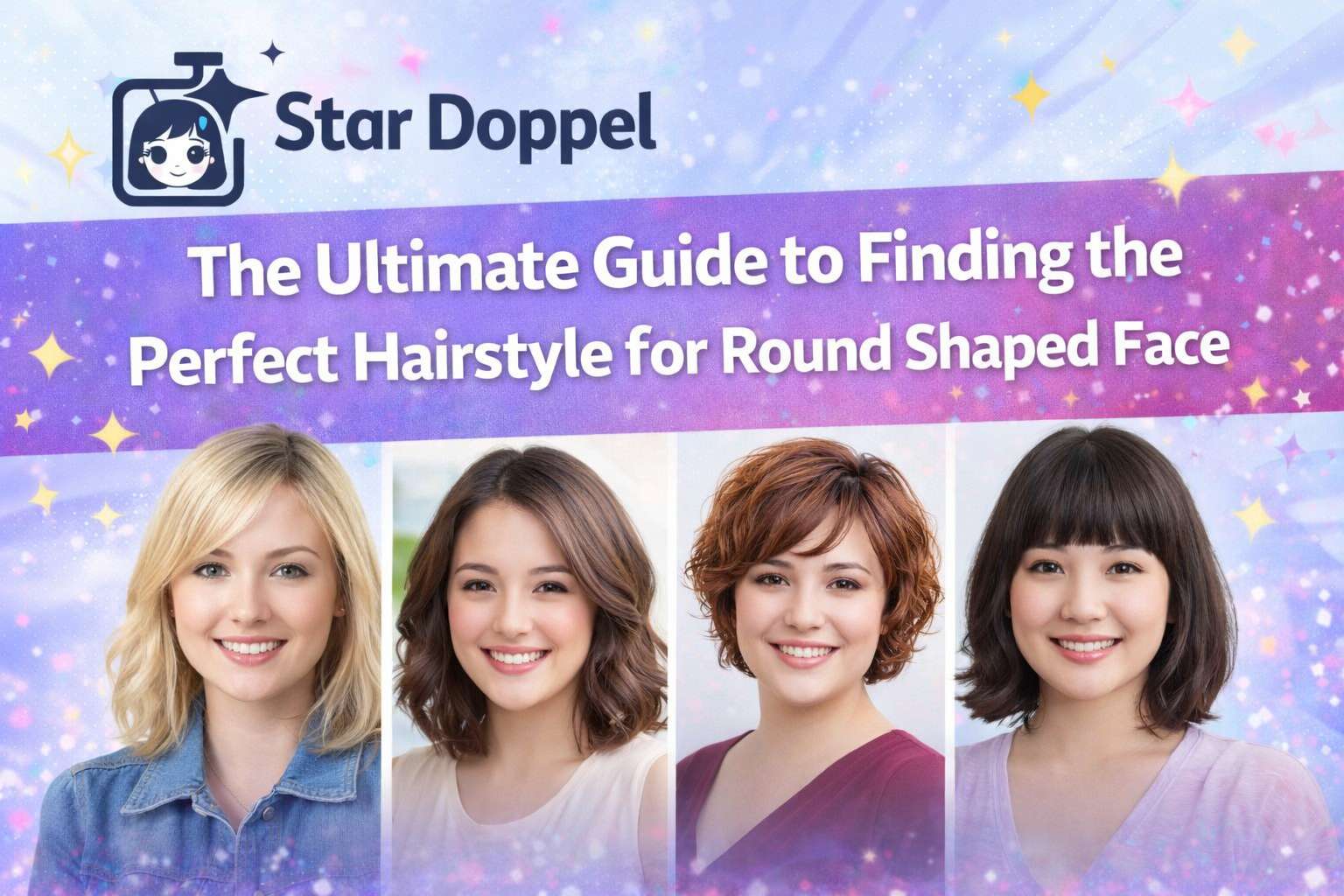
A round face is defined by soft curves fuller cheeks and width that sits roughly equal to length with no sharp jaw angle anywhere along the outline. The most flattering hairstyles for this shape generally work by adding visual length and breaking up that natural roundness. Here is the full logic behind why certain cuts work along with specific styles for both men and women.
(Not sure if you have a round face? Confirm with our AI Face Shape Detector.)
The Core Styling Principle for Round Faces
Every recommendation in this guide follows the same underlying logic. Add height. Add angles. Avoid extra width right at the cheek line. Round faces already carry soft even width so styles that add more width at the sides such as a blunt bob that hits right at the jaw tend to emphasize roundness rather than balance it. Styles that draw the eye upward or introduce a bit of angularity consistently create the most flattering effect.
Best Hairstyles for Women with Round Faces
Long Layers
Layers starting below the chin add vertical movement and visual length which helps elongate the overall silhouette. The longer the layers extend past the jaw the more elongating the effect tends to be.
Angled Bob
A bob cut at an angle, shorter in the back and longer toward the front, avoids the width emphasizing effect of a blunt even length bob. The angle itself creates a subtle vertical line along the jaw that a straight cut does not provide.
Deep Side Part
One of the simplest lowest effort changes with real visual impact. A deep side part breaks the natural symmetry of a round face and adds asymmetrical interest that a centered part simply does not offer.
Face Framing Pixie
For those who prefer short hair a pixie with longer textured pieces around the face rather than uniformly short hair all over avoids exposing the full roundness of the face shape.
Soft Waves with Volume at the Crown
Adding volume specifically at the crown rather than throughout elongates the face by introducing height at the top which helps balance the width sitting at the cheeks.
Best Hairstyles for Men with Round Faces
Pompadour
Significant height at the front and top directly counters width at the cheeks which makes this one of the most reliably effective cuts for a round face.
Faux Hawk
Similar logic to the pompadour. Height through the center draws the eye vertically while shorter sides avoid adding any extra width.
Textured Quiff
A shorter more casual alternative to the pompadour built around the same height focused principle and suited to a more relaxed personal style.
Angular Fade with Length on Top
Tight sides paired with noticeably more length on top creates a strong vertical contrast that works well against the soft horizontal lines naturally present in a round face.
Styles Worth Avoiding
Very short uniform buzz cuts and styles carrying heavy width at the sides tend to emphasize roundness rather than balance it, since they remove the height contrast that flatters this particular shape.
Hairstyle Comparison Table
| Style | Who It Suits | Why It Works |
|---|---|---|
| Long layers | Women wanting length | Adds vertical movement past the jaw |
| Angled bob | Women wanting short to medium hair | Avoids the width of a blunt cut |
| Deep side part | Anyone, low effort change | Breaks natural symmetry for asymmetry |
| Pompadour | Men wanting height | Directly counters cheek width |
| Angular fade with length on top | Men wanting a modern cut | Strong vertical contrast against soft curves |
Styling and Product Tips
- Volumizing products at the roots. Mousse or a root lift spray helps maintain crown height throughout the day which is central to most round face flattering styles.
- Texturizing spray. Adds the kind of piecey undone texture that works well with face framing layers and prevents hair from sitting too smooth and round against the face.
- For men, a matte clay or paste. This tends to suit the textured height focused styles recommended above better than a high shine slicked back finish.
Maintenance Schedule
Layered and textured cuts, the kind generally recommended for round faces, need more frequent maintenance than blunt one length cuts to keep their shape and angle intact. A trim every six to eight weeks is a reasonable general guideline for keeping layers and angles crisp rather than letting them grow out and lose their shape.
How to Confirm You Actually Have a Round Face
Before committing to any of these styles it helps to be sure the underlying face shape is correct.
- Check whether your face width and length appear roughly equal rather than noticeably longer in one direction.
- Look for full soft cheeks as the widest point of your face rather than the jaw or forehead.
- Confirm your jawline curves smoothly without a sharp defined angle.
A measurement based face shape tool can confirm this more reliably than a mirror check alone since posture and slight head tilt can distort self assessment.
Why Height and Angles Work Structurally
The logic behind these recommendations comes down to basic visual proportion. A round face reads as short and wide because the eye takes in roughly equal horizontal and vertical space at a glance. Introducing height at the crown stretches that vertical measurement upward in the viewer’s perception even though the underlying bone structure has not changed at all. Angles work the same way by breaking up the continuous smooth curve of the jaw and cheek with a defined line, which the eye reads as more structured rather than soft. This is why the same core principle, height plus angles plus avoiding extra width at the cheek, repeats across nearly every recommended style rather than being unique to any single cut.
Common Mistakes to Avoid
- Choosing a style based on a photo without checking the underlying logic. A style that looks great on someone with a different face shape will not translate the same way onto a round face, even if the cut itself looks appealing in a photo.
- Going too short without keeping height at the crown. Extremely short uniform cuts remove the one variable, vertical height, that consistently helps balance this shape.
- Overusing heavy shine products. A high shine finish can make hair sit flatter and smoother against the head which works against the textured lifted look that flatters a round face.
- Ignoring maintenance frequency. Layered and angled cuts lose their shape faster than a blunt cut, so skipping regular trims can quietly undo the balancing effect the style was chosen for in the first place.
Confirming Your Face Shape With AI Analysis
Since these recommendations are built specifically around round face proportions it is worth confirming the shape itself before committing to a full styling change. An AI based face shape detector maps landmark points across the forehead cheekbones and jawline from a single clear photo to determine which category best fits, which tends to be more consistent than a self assessment done through a mirror. Pairing a confirmed face shape result with the styling logic in this guide removes the guesswork entirely rather than relying on assumption alone.
Frequently Asked Questions
What is the single most effective change for a round face?
Adding height at the crown is the most consistently recommended technique since it directly counters the width equals length proportion that defines a round face.
Should bangs be avoided entirely with a round face?
Not necessarily. Straight across blunt bangs can emphasize roundness but side swept or longer face framing bangs generally work well by adding asymmetry to the overall look.
Do these recommendations apply the same way to curly hair?
The same height and angle principles apply though curl pattern affects how volume naturally sits. Curly hair often already carries some crown volume which can be worked with rather than added separately.
Can the right haircut really make a noticeable difference?
Yes. Hairstyle is one of the most immediate and reversible ways to visually balance a face shape often with more noticeable impact than makeup or accessory choices alone.
How often should a round face haircut be trimmed to keep its shape?
A trim every six to eight weeks is a reasonable guideline for layered and angled cuts since these styles rely on crisp shaping that grows out faster than a simple blunt cut.
Do glasses frames matter alongside hairstyle for a round face?
Yes. Angular or rectangular frames tend to complement the same height and structure principles used in hairstyling, adding definition that a round face does not naturally have on its own.
Is it worth confirming face shape before choosing a new hairstyle?
Yes. Since these recommendations are built specifically for round proportions, confirming the shape with an AI based detector or a careful self check helps avoid choosing a style built for a different face shape entirely.
Can facial hair help balance a round face for men?
Yes. A beard with more length and slight tapering along the jaw can add the same vertical structure that height focused hairstyles provide, working alongside the haircut rather than replacing it.